OuroSelf-hosted Luau 0.748 in pure Luau.
Parse. Compile. Execute.
Ouro.parse lowers Luau syntax, type annotations, and .d.luau declarations into flat numeric arenas with zero-based byte offsets. Enable lossless = true to preserve exact whitespace and comments for reconstruct(), or materialize node tables with Ouro.Ast.toTables.
local Ouro = require("./ouro")

local source = "-- keep comments\nlocal x: number = 20 + 22\nreturn x"
local parsed = Ouro.parse(source, { profile = "studio", lossless = true })

if parsed.status == "ok" then
	print(parsed:kindName(parsed.root)) -- "AstStatBlock"
	assert(parsed:reconstruct() == source)
endlocal bytecode = assert(Ouro.compile("local a, b = ...\nreturn a * b + 2", {
optimizationLevel = 2,
}))
print(Ouro.Bytecode.disassemble(bytecode))The compiler emits Luau bytecode (v14 default, v100 for classes) across optimization levels 0, 1, and 2, matching upstream constant folding, builtin fastcalls, inlining, and loop specialization.
local base = Ouro.VM.createEnvironment({ answer = 40 }, { readOnly = true })
local env = Ouro.VM.sandbox(base)
local chunk = assert(Ouro.load("return answer + 2", {
	name = "=example",
	env = env,
	instructionLimit = 100_000,
	timeout = 1,
}))

print(chunk()) -- 42
Ouro.load runs raw source, binary bytecode, or a decoded ProtoModule inside an isolated register VM (inheritHost = false by default) with instruction, call, wall-clock timeout, allocation caps, global hooks, and debugger callbacks.
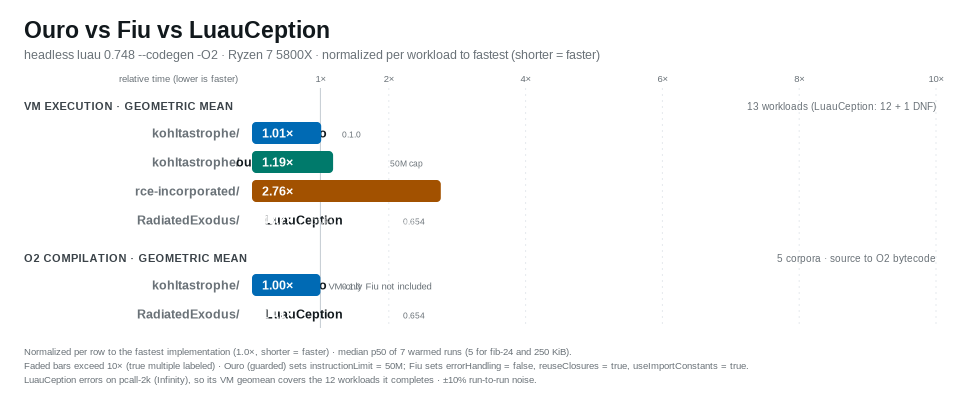
Dual @native dispatch loops keep Ouro fast on both native-codegen and interpreter hosts while cutting startup cost through lazy submodule loading. Explore the full per-workload numbers in Benchmarks.